
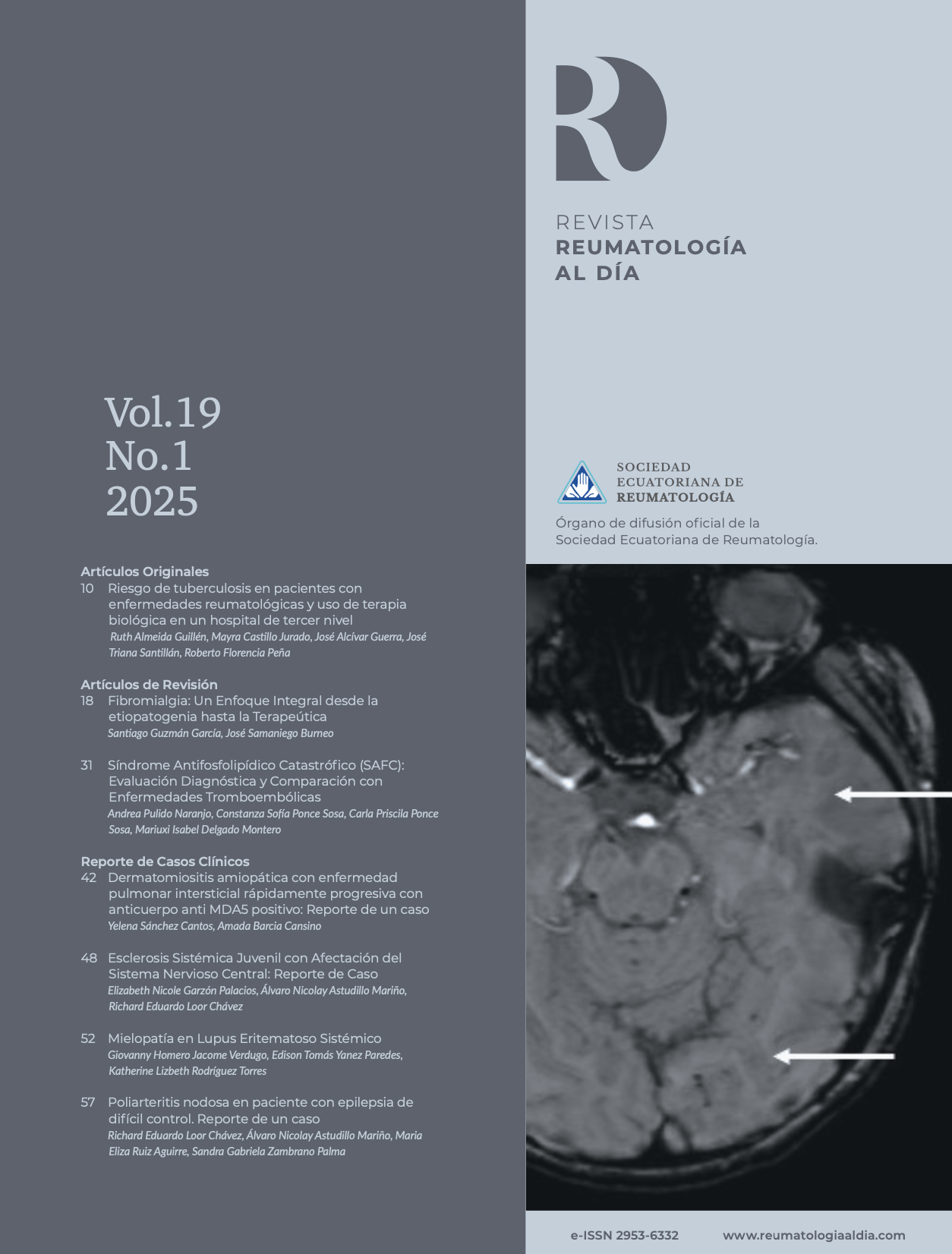
Esclerosis Sistémica Juvenil con Afectación del Sistema Nervioso Central: Reporte de Caso
 Elizabeth Nicole Garzón Palacios
- Richard Loor Chávez
- Álvaro Nicolay Astudillo Mariño
Published 2025-05-01
Keywords
- Esclerosis Sistémica,
- convulsión,
- esclerosis sistémico juvenil,
- afectación neurológica
How to Cite
Copyright (c) 2025 Reumatología al Día

This work is licensed under a Creative Commons Attribution-NonCommercial-NoDerivatives 4.0 International License.
Abstract
La esclerosis sistémica juvenil (ESJ) es una enfermedad rara del tejido conectivo, de origen desconocido, caracterizado por aumento del depósito de colágeno que produce fibroris y degeneración de la piel y de órganos internos. Sin embargo, la afectación del sistema nervioso central que incluye convulsiones, es poco prevalente. La variante juvenil correspende a menos 10% de casos de esclerosis sistémica (ES), con una incidencia anulas 0.27 a 1 por millon de niños en Europa y EEU. La edad promedio de inicio es 8 a 10.5 años. Aunque la incidencia es baja, describimos un caso raro de una niña de 14 años con ESJ que mostró afectación del sistema nervioso central.
Metrics
References
- Rahman A, Uddin M. Juvenile Systemic Sclerosis- A Case Report. TAJ J Teach Assoc. el 3 de diciembre de 2018;29(2):70–2. DOI: https://doi.org/10.3329/taj.v29i2.39112
- Herrick AL, Ennis H, Bhushan M, Silman AJ, Baildam EM. Incidence of childhood linear scleroderma and systemic sclerosis in the UK and Ireland. Arthritis Care Res. febrero de 2010;62(2):213–8. DOI: https://doi.org/10.1002/acr.20070
- Beukelman T, Xie F, Foeldvari I. Assessing the prevalence of juvenile systemic sclerosis in childhood using administrative claims data from the United States. J Scleroderma Relat Disord. junio de 2018;3(2):189–90. DOI: https://doi.org/10.1177/2397198318763701
- Lehman TJA. Systemic and localized scleroderma in children: Curr Opin Rheumatol. noviembre de 1996;8(6):576–9. DOI: https://doi.org/10.1097/00002281-199611000-00013
- Héron E, Fornes P, Rance A, Emmerich J, Bayle O, Fiessinger JN. Brain Involvement in Scleroderma: Two Autopsy Cases. Stroke. marzo de 1998;29(3):719–21. DOI: https://doi.org/10.1161/01.STR.29.3.719
- Navon P, Halevi A, Brand A, Branski D, Rubinow A. Progressive systemic sclerosis sine scleroderma in a child presenting as nocturnal seizures and Raynaud’s phenomenon. Acta Paediatr. enero de 1993;82(1):122–3. DOI: https://doi.org/10.1111/j.1651-2227.1993.tb12539.x
- Cutolo M, Nobili F, Sulli A, Pizzorni C, Briata M, Faelli F, et al. Evidence of cerebral hypoperfusion in scleroderma patients. Rheumatology. diciembre de 2000;39(12):1366–73. DOI: https://doi.org/10.1093/rheumatology/39.12.1366
- Bhardwaj A, Badesha PS. Seizures in a patient with diffuse scleroderma. Postgrad Med J. el 1 de noviembre de 1995;71(841):687–9. DOI: https://doi.org/10.1136/pgmj.71.841.687
- Medsger TA. Assessment of damage and activity in systemic sclerosis. Curr Opin Rheumatol. noviembre de 2000;12(6):545–8. DOI: https://doi.org/10.1097/00002281-200011000-00012
- Zulian F, Woo P, Athreya BH, Laxer RM, Medsger TA, Lehman TJA, et al. The Pediatric Rheumatology European Society/American College of Rheumatology/European League against Rheumatism provisional classification criteria for juvenile systemic sclerosis. Arthritis Rheum. el 15 de marzo de 2007;57(2):203–12. DOI: https://doi.org/10.1002/art.22551
- Preliminary criteria for the classification of systemic sclerosis (scleroderma). Subcommittee for scleroderma criteria of the American Rheumatism Association Diagnostic and Therapeutic Criteria Committee. Arthritis Rheum. mayo de 1980;23(5):581–90. DOI: https://doi.org/10.1002/art.1780230510
- Khanna D, Furst DE, Clements PJ, Allanore Y, Baron M, Czirjak L, et al. Standardization of the modified Rodnan skin score for use in clinical trials of systemic sclerosis. J Scleroderma Relat Disord. 2017;2(1):11–8. DOI: https://doi.org/10.5301/jsrd.5000231
- Distler O, Del Rosso A, Giacomelli R, Cipriani P, Conforti ML, Guiducci S, et al. Angiogenic and angiostatic factors in systemic sclerosis: increased levels of vascular endothelial growth factor are a feature of the earliest disease stages and are associated with the absence of fingertip ulcers. Arthritis Res. 2002;4(6):R11. DOI: https://doi.org/10.1186/ar596
- Rabquer BJ, Koch AE. Angiogenesis and vasculopathy in systemic sclerosis: evolving concepts. Curr Rheumatol Rep. febrero de 2012;14(1):56–63. DOI: https://doi.org/10.1007/s11926-011-0219-1
- Katsumoto TR, Whitfield ML, Connolly MK. The pathogenesis of systemic sclerosis. Annu Rev Pathol. 2011;6:509–37. DOI: https://doi.org/10.1146/annurev-pathol-011110-130312
- Nobili F, Cutolo M, Sulli A, Vitali P, Vignola S, Rodriguez G. Brain functional involvement by perfusion SPECT in systemic sclerosis and Behçet’s disease. Ann N Y Acad Sci. junio de 2002;966:409–14. DOI: https://doi.org/10.1111/j.1749-6632.2002.tb04241.x
- Tai CC, Lee P, Wood RE. Progressive systemic sclerosis in a child: case report. Pediatr Dent. 1993;15(4):275–9.
- Amaral TN, Peres FA, Lapa AT, Marques-Neto JF, Appenzeller S. Neurologic involvement in scleroderma: a systematic review. Semin Arthritis Rheum. diciembre de 2013;43(3):335–47. DOI: https://doi.org/10.1016/j.semarthrit.2013.05.002
- Foeldvari I, Wierk A. Healthy children have a significantly increased skin score assessed with the modified Rodnan skin score. Rheumatol Oxf Engl. enero de 2006;45(1):76–8. DOI: https://doi.org/10.1093/rheumatology/kei106